*

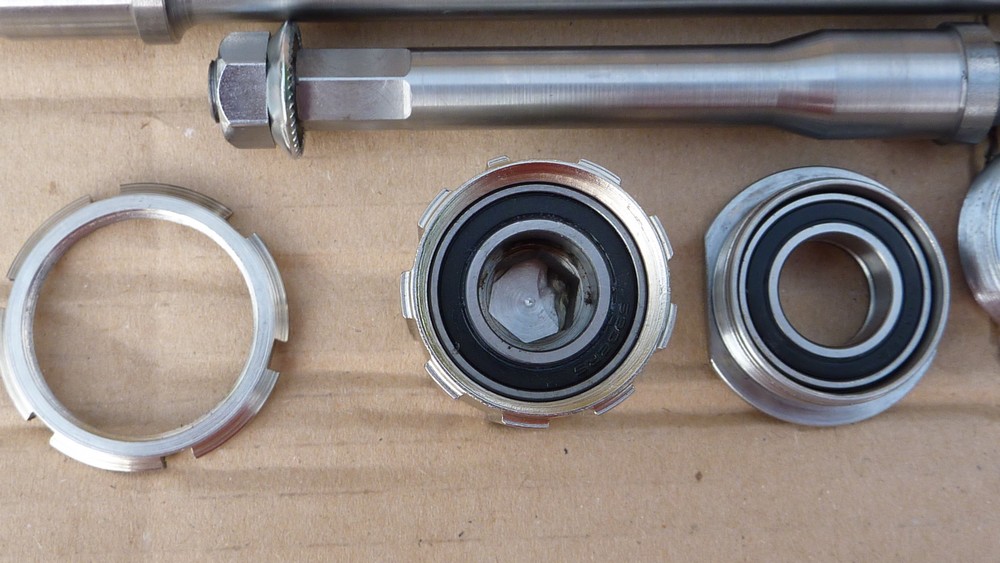
The working parts of the Trykit 2WD, double free-wheel drive "freehub".
The entire assembly floats on the inner ends of the two rear axles. Supported by the push fit, oversized, sealed, journal ball bearings. Being so well sealed the bearings offer excellent protection for the internal ratchets, pawls and their carriers. The Shimano cassette fit, 2WD freehub body itself is machined from high quality steel, hardened and plated. The central disk spacer is to aid pushing out the pawl carriers for examination. The pawl carriers have hexagonal bores to take the drive from the mounted cassette, independently, to both rear axles. The Trykit 2WD freehub offers two wheel drive in a compact, robust and lightweight package. The Trykit freehub is easily dismantled without tools. The pawl and their springs are always safely retained in their carriers. So nothing can "fly away" during occasional dismantling for inspection and possible re-lubrication with a light grease.
_________________________________________________________
I will just scribble a few notes before bedtime while the first 2WD riding experience is fresh in my mind:
It was nearing 7pm when I had finished assembly of the Trykit 2WD system of twin free-wheels in a specially made "freehub" style body. I tightened and checked the wheel nuts and pointed the trike down the gravel drive. Just as I had done several hundred times before. I had not refitted my large cloth shopping bag so the trike felt quite a bit lighter and more "agile" than usual. I immediately noticed a front wheel wobble and so did my wife who was seeing me off. The wobble was odd but inexplicable. I had quickly checked the tyre pressures and head bearings. No obvious problems there. (In retrospect I think the wobble was the trike trying to overcome my reluctance to let it have its head. I was fighting my ingrained instincts to resist the constant rightwards turning tendency of 1WD. Causing the trike to feel as if it was weaving)
I took it easy until I reached the road. The trike felt very strange. As if I was learning how to ride one all over again. It seemed to be weaving slightly when I pedalled hard. A bit worrying at first but nothing seemed about to fall off. Once on the road I gradually built up speed until I was doing my usual 20mph. I let go of the handlebars while still pedalling hard up a slight incline and found the trike kept a dead straight course! Normally it would have headed straight for the verge in a hurry.
I rode on to the nearest real hill, pedalling hard and still feeling a slight weaving effect. There I found that I could climb without holding the handlebars. This was novel indeed! Normally the front wheel would almost lift off the road and jerk viciously to the right on every pedal stroke. I liked this new neutrality a lot. I went in search of a steeper hill to check my findings. The trike still felt fast and agile but seemed to be steering itself at times. Particularly if I deliberately pedalled hard enough to bend the entire trike into a weaving motion at lower pedal revs. The feeling was as if the head bearings were stiff. Though they are actually far too loose and really need replacing.
Cornering had taken on an interesting new feel depending whether I pedalled hard or just tried to maintain speed. Some times it almost seemed to under-steer. At others it was completely neutral. I rode loops up and down on the steepest local hill (fortunately a very quiet lane) to test out my feelings about this 2WD.
My immediate conclusion is that I would have had far less trouble learning to ride a trike with 2WD. It no longer had the nasty 1WD vices which had made me over-react in the early days and later. The feeling of danger as the trike headed for the verge with a mind of its own was now completely absent. I could now maintain a smooth line on heavy camber no matter how hard I pedalled. The slight under-steer was merely a lack of turning motion from the former 1WD. As was the slight weaving. The trike wasn't misbehaving any more but it felt as it was doing the complete opposite. I was actually sensing the trike correcting itself. Instead of my having to make constant subconscious corrections for its 1WD faults. (i.e.Its unwanted clockwise turning tendency)
I had read that a disadvantage of 2WD was the inner wheel drive making it harder to pull away or turn sharply at low speed. I found no such problems. I turned tight circles on the steep hill without any untoward resistance to my pedalling. Though admittedly I was already in a low gear.
The absence of sideways pull was delightful. I had theorised endlessly for many months, before ordering the Trykit 2WD. How it would cope with European camber? How would it know which wheel to drive to lift the trike out of the right side gutter? The strange answer is that it simply does know what to do without trying.
I could only manage about half an hour, and five miles of messing about on the lanes, before I had to return home to tidy up. My impressions so far are all entirely positive! I couldn't resist trying to sprint out of the saddle on our very loose, gravel drive just for fun. Normally I can get the drive wheel to spin effortlessly even while sitting down. It always took quite a distance to get any real speed up. With 2WD I accelerated hard and shot down the drive without so much as the slightest slip of my smooth and skinny 700 x 23mm tyres. Absolutely amazing!
I cannot imagine anybody being able to compete on grass or gravel with 1WD against machines fitted with Trykit 2WD mechanisms. It would be hardly worth turning up for a grass track race with 1WD. Not unless the grass was bone dry, there were no straights and the course ridden clockwise. This would put the drive wheel on the outside where it would gain most grip from any tipping tendency on the curves.
BTW: There is zero sensation through the pedals of the drive shifting from one axle to the other. I had worried about this too but there is absolutely nothing to report. Naturally I shall share my experiences further when I have had a proper ride tomorrow. I am looking forward to it even more than usual. The slightly wider track seems to have taken away some of the lateral vibration on rough roads. It feels much more steady. A bit like my even wider and more sedate Longstaff conversion but much lighter and more lively. It's a shame I have to put the big shopping bag back on tomorrow.
----------------------------------------------------------
24th September 2010. My first proper ride with the Trykit 2WD fitted. The big bag was lashed back onto the seat stays. The immediate impression was how fast, relaxed and effortless the trike had become. Instead of crabbing constantly to the right all my energy was now going into forward motion. The effect was very noticeable on undulating roads. The friction of the front tyre pressing sideways against the road was now completely absent. I was blasting along up hill and down dale at speeds I could only dream about before today. I was climbing hills on the middle chainring which needed the small one only yesterday.
The most noticeable effect on the flat is when cornering to the right on really steep camber. I used to avoid the inside of these corners and ride as far out as I dared, depending on following traffic. Now the 2WD could be used to physically lift the trike up the camber simply by pedalling a little harder. Pedal too hard and it felt (almost) as if I could end up in the middle of the road! I really don't think this was an unwanted vice with the 2WD system. More like a lack of 2WD experience on my part. Compensating for the ingrained turning effect of OWD would take some time to unlearn.
After ~10,000 miles of riding one wheel drive trikes over the last 18+ months I have yet to reprogram myself to the completely different sensations with 2WD. I have been subconsciously compensating for so long, that not having to do so, feels like the 2WD is pushing me the opposite way. In fact the two wheel drive is completely neutral. It is my own senses which are still wrong from becoming so accustomed to the bad habits of OWD.
Climbing steep hills was a revelation! I deliberately went looking for hills to test out the 2WD system. No more snatching to the right! The trike just keeps its nose pointing in the right direction. I could even loose my grip on the handlebars and stay on the straight and narrow! This is truly stunning performance after struggling for a year with the OWD vices on the Higgins. The 2WD actually seems to flatten the hills out. They are no longer the test of patience and gritting my teeth which they once were.
There were some odd moments when I was pulling away when it felt as if the trike wanted to go its own way. (though only slightly) This depended on the starting angle of the handlebars. Again this was because I no longer needed to turn the bars so far to overcome the strong 1WD turning tendency to the right. Low pedal revs and low speed seems to find an occasional feeling of weaving. Perhaps this too is my automatically compensating for a now-missing 1WD vice? My normal cadence of 90+rpm eliminates any tendency to weave.
Those of you living in a country where traffic drives on the right would do well to consider the Trykit 2WD system. Highly recommended based on the 30 miles so far.
----------------------------------------------------------------
I managed another 17 miles this afternoon while concentrating hard on what I sensed about the 2WD system. Again the ride was more relaxed, secure, quieter and still felt much quicker than usual. It really is difficult to separate the 2WD effects from my own "automatic pilot" OWD reactions. Occasionally as I crested the brow of a low hill while pedalling hard the trike felt as if it wanted to go straight on. I'm almost sure this was due to my own senses being fooled by the lack of the usual turning tendency to the right.

Trykit 2WD with 8 speed Shimano cassette. I made the brass spacer ring in the lathe.
Old habits die hard and 40-odd miles is not enough to undo thousands of miles of ingrained expectations. I have become so accustomed to the OWD that even a neutral force will feel as if it is pushing the other way. Just as a trike feels as if it is pushing you about when you first change over from a bike.
I have been trying to sprint out of the saddle far more than usual and find the trike has quite a strong "straight ahead" tendency. Easily overcome with a slight turn of the handlebars but slightly unexpected for the habitual OWD rider. What is surprising is that the tyres are much quieter when not slipping about on every bit of sand and gravel at junctions. The lack of wheel spin feels much more secure in traffic.
I have discovered one slight, unforeseen problem so far. If I stop in a high gear I can no longer just lift the drive wheel to drop onto a lower gear with a flick of the pedals. So pulling away takes a bit longer while I find a lower gear. I shall just have to learn to drop onto a smaller chainwheel as I come to a halt each time. No real hardship with a little practice. If the trike wasn't so heavily loaded I could lift the whole back end to drop down a few gears while at a standstill.
The extra half inch of track width is well worth having on rough roads. The trike no longer behaves quite like the bucking bronco which I have become so used to on the badly maintained lanes and roads.
In summary, I would suggest that riding a OWD (one wheel drive) trike is handicapping both yourself as a rider and the capabilities of the machine itself. The advantages of 2WD make the choice automatic for trike riders living outside the UK. Even within the UK, where you have the benefit of OWD to lift the trike out of the left gutter, then a Trykit 2WD still makes a lot of sense.
On the Higgins you get new, stronger axles without the stress raising machining at the most critically loaded points of both axles. You get considerable freedom from wheel spin on wet roads, steep inclines, fords, grass, sand, snow, ice and gravel. Climbing steep hills will become much easier. Any tendency for the machine to try and turn right is completely eliminated. No doubt you'd get much lighter tire wear into the bargain. Once 2WD has been tried there is no going back to OWD. To do so would be unthinkable.
-----------------------------------------------------------------
Another update: I have discovered that I can ignore camber with 2WD. My habit of riding on the crown of the road on heavily cambered lanes is now unnecessary. The terrifying bits of camber of the last 18 months have been neutralised. There were many places where it was simply too awkward to pedal while leaning so far over to compensate for the trike's own lean. So I completely avoided riding on the right just there. I really resented the odd passing car which forced me back into the danger zone. Now I can sit upright and pedal effortlessly along. No awkwardness or discomfort. Not even the sense of fear that I might actually tip over if I miscalculated my degree of lean. Or found a sunken place where the camber dropped away even more. This is quite a shocking discovery after all the time and thousands of miles I have covered travelling these same lanes. My triking experience is transformed even more than the new ease of climbing. I feel so much more at one with the machine. As it urges me over every obstacle which once caused me problems. This is all thanks to the Trykit 2WD system.
---------------------------------------------------------------
[30 Sept] Yet another update: I am still delighted with all the advantages of 2WD. I have discovered that the system can be fooled if heavy pedal pressure is applied in a low gear with the handlebars turned sharply. Even a short incidence of wheel spin is possible if one tries hard enough. Over time I have detected a slight "straight ahead" tendency when pedalling hard. I can't imagine anyone finding this obnoxious unless they regularly ride with no hands on the bars. And, if they did, they would have ended up going round in circles with OWD. With 2WD you stay on the tarmac.
There is a greater pedal resistance to turning sharply at the traffic exclusion barriers (chicanes) on bicycle paths. But exactly the same occurred previously on the opposite lock with OWD. All it takes is the forethought to drop a gear or two for the likely speed involved in negotiating the barriers. Now I just drop automatically onto the smallest chainwheel.
There is a greater pedal resistance to turning sharply at the traffic exclusion barriers (chicanes) on bicycle paths. But exactly the same occurred previously on the opposite lock with OWD. All it takes is the forethought to drop a gear or two for the likely speed involved in negotiating the barriers. Now I just drop automatically onto the smallest chainwheel.
The trike still rolls away (all too eagerly) going forwards or backwards when parked on the slightest incline. So there has been no increase in low speed axle friction. Quite the contrary. On descents the trike seems even faster. I have exceeded 35mph where my norm was 29-30mph free-wheeling down one local hill. I seem to be going faster on the flat too. I am also returning from my daily rides in better shape than ever before.
Camber has become almost irrelevant and the tiredness in my arms from constantly fighting it has completely gone. It amazes me to remember how some heavily cambered roads used to make me feel very unsafe indeed. Even after nearly a year of riding them regularly. Now they seem completely innocuous no matter how fast or hard I pedal. I could never quite believe the degree of handlebar turn required just to maintain a straight line on a heavily cambered, straight road.
Sprinting out of the saddle with OWD was a complete joke. Even when I didn't get instant wheel spin the trike still wanted to head for the nearest weeds on the right. With 2WD it is much more like riding a bike. I now consider myself excused from climbing long hills out of the saddle. Because I don't want to risk my knees. I climbed one long and steep hill in a high gear [48 x 14] this week just to see if I could. My knees were the only part of me to complain so I'm not trying that again! It is so much easier to sit and twiddle my way uphill now.
Camber has become almost irrelevant and the tiredness in my arms from constantly fighting it has completely gone. It amazes me to remember how some heavily cambered roads used to make me feel very unsafe indeed. Even after nearly a year of riding them regularly. Now they seem completely innocuous no matter how fast or hard I pedal. I could never quite believe the degree of handlebar turn required just to maintain a straight line on a heavily cambered, straight road.
Sprinting out of the saddle with OWD was a complete joke. Even when I didn't get instant wheel spin the trike still wanted to head for the nearest weeds on the right. With 2WD it is much more like riding a bike. I now consider myself excused from climbing long hills out of the saddle. Because I don't want to risk my knees. I climbed one long and steep hill in a high gear [48 x 14] this week just to see if I could. My knees were the only part of me to complain so I'm not trying that again! It is so much easier to sit and twiddle my way uphill now.
Overall there is really nothing much to criticise about the Trykit 2WD "double freewheel" system. Climbing has become a real pleasure instead of an irritating chore. I still have to pedal (of course) but there is a real sense of going full ahead. Instead of crabbing constantly off to the right. Not to mention the former, vicious, handlebar movements of OWD on steeper climbs. I now find it much easier to maintain a high cadence in a lower gear and still maintain a good speed. The overall effect is one of it being much less tiring to climb any hill. There is a very real sense of improved climbing power for the same input.
Nothing would induce me to return to OWD now. In fact it would take an awful lot of the fun out of tricycling to have to go back to OWD. My average speed, according to my bike computer, has risen only recently by about 1 mph from 13 to 14mph based on a 2.5k recorded mileage. Given the constantly undulating nature of any ride I am rather cheered by this improvement.

Nothing would induce me to return to OWD now. In fact it would take an awful lot of the fun out of tricycling to have to go back to OWD. My average speed, according to my bike computer, has risen only recently by about 1 mph from 13 to 14mph based on a 2.5k recorded mileage. Given the constantly undulating nature of any ride I am rather cheered by this improvement.

The stealth, Trykit 2WD, double freehub fitted with an 8 speed Shimano cassette.
The gear cable would be much better dressed to run outside the vertical reinforcing loop.The wear on the paint suggests this was the usual route.
The gear cable would be much better dressed to run outside the vertical reinforcing loop.The wear on the paint suggests this was the usual route.
Please remember that all my remarks apply to riding on the right hand side of the road in Continental Europe. UK tricyclists with OWD should try to find somebody with 2WD to see if the same advantages apply. The normal road camber works in favour of OWD in the UK. My own (necessarily) short experiments with riding on the left suggest that most of my trike's nasty OWD vices were much reduced. Those required to ride on the right in their own country should consider this 2WD system a "no brainer".
I won't discuss the price of the Trykit 2WD system because we all place different values on our cycling expenses. Compared with many accessories the 2WD is likely to offer considerable improvement in performance compared with items which are merely cosmetic. A flashy chainset won't make you go an inch per hour faster than a cheap one but is highly decorative. While an almost invisible Trykit 2WD will completely transform a OWD trike.
The Trykit Longstaff 2WD conversion is considerably cheaper than the Higgins type. Making it an even more obvious upgrade over OWD. Remember that you get brand new and much stronger axles with the Higgins conversions. You also get freedom from future axle maintenance by the conversion to journal bearings. My own experience is that these journal bearings (and their seals) do not affect rolling resistance at all. If anything they offer a very slight reduction IMO. Particularly over a badly-adjusted or badly worn, loose ball, cup and cone bearing system. You can even choose to change the hub fitting of the new Higgins axles to Longstaff or Trykit 15mm dimensions. Or even have the axles adapted for modern disk or spoked carbon fibre rear wheels for time trialling. Geoff Booker will machine axles to any reasonable requirement.
In use the Trykit system is totally silent. Thanks to the many pawls and fine ratchet teeth, drive take-up is instantaneous. There is quite literally no hesitation at all. Only when walking the trike slowly under quiet conditions can one actually hear the gentle buzz of the pawls "free-wheeling".
Spinning the rear wheels via the pedals (with the trike on a work stand) it seems to take ages for the wheels to come to a complete stop. Any imbalance in the wheels will show as the wheel rolls gently back and forth slowly before finally settling. This shows just how free the entire 2WD system really is. Those presently limited to an old-fashioned, obsolete, screw-on sprocket block, or even fixed wheel, will gain the freedom to fit a gear cassette of your own choice of up to 10 speeds. Even allowing index gears with a suitable gear lever and rear changer.
It is now two weeks since I fitted the Trykit 2WD. As of the 5th October 2010 I have put over 400 miles on the Trykit 2WD since the 23rd of September. I have not had one single reason to begrudge the cost of the system. Not one second of doubt as to its amazing value in improving the performance of my 1954 Higgins trike quite beyond belief.
Dec 5th update: There are regular positive comments on the Trykit 2WD in the triking diary chapters which follow this one. If there is any doubt as to the efficacy of 2WD then look for my December chapter when the snow arrived. Enlarging the image below (by clicking on it) will show my direct ascent of a snow covered hill. Rising in a series of steps it is quite steep enough throughout to be tiring to climb at any time. On snow I was able to maintain a reasonable speed without any wheelspin.I won't discuss the price of the Trykit 2WD system because we all place different values on our cycling expenses. Compared with many accessories the 2WD is likely to offer considerable improvement in performance compared with items which are merely cosmetic. A flashy chainset won't make you go an inch per hour faster than a cheap one but is highly decorative. While an almost invisible Trykit 2WD will completely transform a OWD trike.
The Trykit Longstaff 2WD conversion is considerably cheaper than the Higgins type. Making it an even more obvious upgrade over OWD. Remember that you get brand new and much stronger axles with the Higgins conversions. You also get freedom from future axle maintenance by the conversion to journal bearings. My own experience is that these journal bearings (and their seals) do not affect rolling resistance at all. If anything they offer a very slight reduction IMO. Particularly over a badly-adjusted or badly worn, loose ball, cup and cone bearing system. You can even choose to change the hub fitting of the new Higgins axles to Longstaff or Trykit 15mm dimensions. Or even have the axles adapted for modern disk or spoked carbon fibre rear wheels for time trialling. Geoff Booker will machine axles to any reasonable requirement.
In use the Trykit system is totally silent. Thanks to the many pawls and fine ratchet teeth, drive take-up is instantaneous. There is quite literally no hesitation at all. Only when walking the trike slowly under quiet conditions can one actually hear the gentle buzz of the pawls "free-wheeling".
Spinning the rear wheels via the pedals (with the trike on a work stand) it seems to take ages for the wheels to come to a complete stop. Any imbalance in the wheels will show as the wheel rolls gently back and forth slowly before finally settling. This shows just how free the entire 2WD system really is. Those presently limited to an old-fashioned, obsolete, screw-on sprocket block, or even fixed wheel, will gain the freedom to fit a gear cassette of your own choice of up to 10 speeds. Even allowing index gears with a suitable gear lever and rear changer.
It is now two weeks since I fitted the Trykit 2WD. As of the 5th October 2010 I have put over 400 miles on the Trykit 2WD since the 23rd of September. I have not had one single reason to begrudge the cost of the system. Not one second of doubt as to its amazing value in improving the performance of my 1954 Higgins trike quite beyond belief.

First, winter, direct ascent of the north face with Trykit 2WD.
I have not needed to add wider, knobbly tyres for the snowy conditions. (as planned) Because there is simply no need. With my existing 23mm wide, dead smooth, rock hard, Bontrager Race Lite, 700C tyres I can climb quite decent hills in several inches of snow.
Though one is completely unaware of it, the moment one wheel starts to slip, drive is instantly taken up by the other wheel. The only way to achieve wheelspin is to turn the handlebars hard to the left or right. Otherwise it seems almost impossible. There is a very steep slope at a supermarket which I visit regularly. It must be about one in four or 25%. This slope has often been covered in snow and ice recently. Even when I'm in a very low gear I simply cannot make the wheels slip on this slope. Absolutely amazing!
Watching cars sliding about as they try to climb lesser slopes reminds us that the differential falls flat on its face in slippery conditions. Instead of each wheel assisting the climb they fight each other. The moment one wheel starts spinning all the drive is sent to that wheel. The opposite occurs with the Trykit 2WD. All the advantages of four wheel drive seem to be achieved with the Trykit two wheel drive on a trike. If the handlebars are kept reasonable straight then both wheels drive together. The grip provided is astonishing. One can stand up on the pedals on a snowy or icy slope and accelerate smoothly without the least wheelspin. No wheelspin at all!
Last winter I was denied many of my regular, minor road routes because I only had 1WD. I couldn't maintain momentum on the same hills with the same tyres due to wheelspin. The advantages of two wheel drive are very obvious. I can continue to use my year-round tyres with their lower rolling resistance on all surfaces. It may be that the skinny tyres can cut through the snow better than wide tyres. Which would probably still sink in just as far. The wider tyres would need to compress a broader track in the snow. So the wider tyres would offer higher drag in all road conditions.
Click on any image for an enlargement. Back click to return to the text.
*