25 Sept 2011

September already 6

*


The rural life.

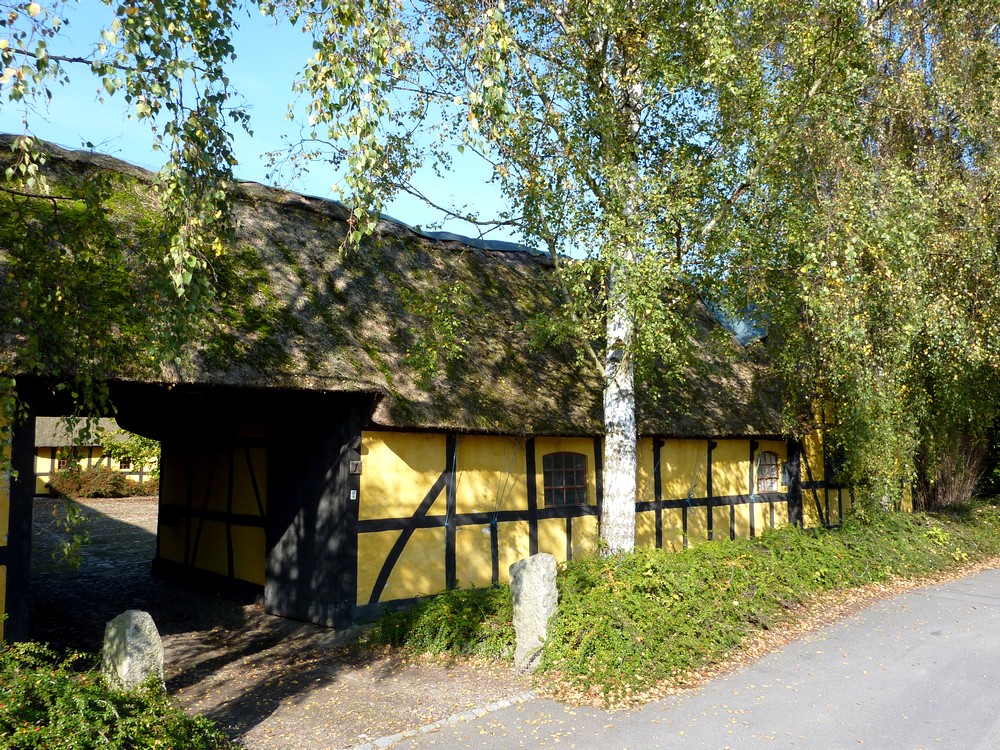
Only a puritanical pedant would decry the elderly occupants the privacy of a leaded glass, bathroom window. Oh, and a picture window dormer to the upstairs bedroom in the barn conversion. This picture is best seen full screen to capture the wonderful softness of the enveloping thatch and the sense of open space. I love the totally honest, front garden, clothes line. This truly is the good life. If only there was a shop within 5 miles! Village shops cannot compete with the lure of the supermarkets. (for those with motorised transport) Pull the ladder up, Jack! I'm alright.

 25th September 50-60F, 10-16C, sunny, light winds. A perfect morning! Still and bright with a light mist. The only problem was the low, bright sun affecting my photography. The camera just can't capture what I see. I can avoid flare but when I expect a gentle softening from the mist the picture just looks out of focus! :-)

After yesterday's fun at t'mill, I deliberately set off to  capture as many thatched houses as possible in a particular area. I returned with 159 new pictures! <blush>

Naturally I can't just make one blog post with so many pictures. So I'll just have to ration them out over a period of time. It takes time just to run them all through PhotoFiltre. To downsize them, adjust contrast and gamma and perhaps to straighten them slightly. 


The barn is as pretty as a picture on this immaculate, former farmhouse.

The main problem with weekends is all the cars parked in front of the prettiest homes. This ruled out quite a few which would otherwise have been photographed. Unless one is very lucky it may be impossible to find an angle to hide the vehicles from view. Once in a while it is possible to blot them out using a cloning tool in PhotoFiltre: As in this example below where I cloned the background over a parked car in the back garden:


Or here (below) where I was able to partially hide the car with a shrub and clone out some junk on the drive. This amazing house on a raised plinth has been defying me a good shot for a year or more. A car always seems to be present. The sunlight was behind the house which reduced the contrast and hides the framing trees. The village church is immediately behind the house. It has a large and noisy bell. As do most Danish village churches.The priest was standing in his Elizabethan collar and robes in the yard behind his house. Off to the right, as the bell was rung briefly at 9am. The congregation could probably have been counted on the fingers of one hand.


 Sometimes the contrast is too great and I have to adjust it downwards:
 

For  the image above I toned the contrast down but also had to stand on somebody's lawn to get far enough away despite the wide angle lens on the TZ7. It is the opposite neighbour's front hedge in the foreground! :-)


With this one I had to make do with photographing the barn. Because the lovely old house had a car obscuring most of the frontage!


This one was so extremely long I had to make use of every inch of the very wide yard to get it all in. It is still an active farm. 


Here I was forced to capture the rough ground of a smallholding.
Realistic, but not the prettiest foreground imaginable.


1860 is the youngest part of this 4 lengths, village centre farm dating back to 1606! This section was the later horse stables. It was rebuilt in brick to extend the original timber-framed barn. The original "bindingsværk"  (timber framing) construction and stalls are still visible inside.


 The roadside façade. With a view into the central yard to the opposite wing.
This part of the building was once the living quarters before it was moved to the adjoining building.


Another gable end on the back of the farm. The central yard and surrounding area are cobbled with field stones. In front of the "stuhuset" the cobbles are arranged in broad strips. With larger stones demarking the borders between them. This is an early sign of a well-to-do farm. Most cobbled yards are just randomly laid. Note how thatch has no gutters. It drips for ages after rain or even a heavy dew! 

This is the original 1606 section. The date is inscribed inside. Now the living rooms part of the enclosing farm buildings. The Danes refer to this as "stuehuset". The house with the living rooms. Again I was lucky enough to see the owner pottering in his yard and he invited me to have a tour round. The house has been on the market for some years and badly needs a new thatched roof. The blue ropes are retaining tarpaulins on the ridges.The tiny window over the door is to provide a little light inside the roof. Sometimes the roof would be used for storage. Or (presumably) bedrooms for the many farm hands.


An old dormer window with the waviest glass I have ever seen in my entire life! This was part of the oldest wing. Nothing else destroys the character of an old building like modern, dead flat, float glass. It has absolutely no character (at all!). Not even if used with a proper number of glazing bars. (Sprosser in Danish)  Note the slender glazing bars in this wonderful old window. These narrow glazing bars blocked the least light and allowed the best possible view. All but disappearing when one looked out of the window.


Yet another view of this charming old farm.
The owner didn't say how long it had been disused for agricultural purposes. (nedlagt landbrug) 

Four hours to do 25.5 miles. Including shopping at two supermarkets (for at least 10 kilos of shopping) and taking 159 photographs. The punctured tyre is "bumping" at speed. Odd, considering the small size of the patch I applied.

This post may stretch slightly but I usually try to limit the number of images. Just to ensure pages open reasonably quickly for all visitors. If everybody was on fast broadband I could stuff each page with lots of very large images. With the very limited, rural, online experience in many countries, this would be rather selfish.

I see the Google gallery idea has vanished again.

In Cav we trust. :-)


Click on any image for an enlargement.

*

24 Sept 2011

September already 5

*


September 25th 2011 50-61F, 10-16C, sunny periods, mostly light winds. 37 miles.

At first I was heading for a distant village. Just to put some miles in. While taking a different route along the narrow rural lanes I saw an enticing turning. Almost immediately I came across an amazing old timber-framed range of buildings set back from the road. There was the typical leaning archway leading into the cobbled yard of what looked like a typical, four-sided, Danish farm.

No sooner had I raised my camera than a gentleman appeared through the archway. Naturally I asked if I might take a photograph. Before I knew it I had been invited in to see the yard, the unspoilt buildings and the remains of the old mill and its pond.

Walking through the arched entrance to the yard was like stepping back in time.

The mill pond lay beyond the house but was much shrunken from its former glory. The remains of the waterwheel shaft were visible and even an old sawmill standing next door.

The archway itself is wonderfully misshapen and sagging in all directions.


The building shown is the stampemølle. (stamping or fulling mill) A belt was driven by the waterwheel which carried the drive to this building. Where large beams were lifted and dropped like oversized hammers. The stampers were used to crush grain and to work cloth. Newly woven wool needed to be beaten to remove oil and to close the weave. Wool cloth would be almost like sackcloth before fulling. It would also be unable to accept dyes until the sheep's natural grease was beaten out of it.


The beautiful old house has an imposing façade. The offset gable is slightly unusual. A central gable façade was almost a standard design for Danish houses of the time. (1830 and later)

I lack a formal name for this style of façade. Too large for a dormer. Too modest for a portico. They are extremely commonplace in Denmark on all styles of building. Both in rural settings and towns.

All the buildings are clearly dated from the same period. Each having beautifully inscribed external beams. 


There is not much to see of the original waterwheel than its axle. Originally a belt would have passed to the right of the picture. The large millpond is beyond and to the left. A stream runs nearby.


Presumably there was status to be had from having upstairs bedrooms. Many timber-framed houses had rows of front and back rooms which were all connected in series. Escaping from the hustle and bustle of the household would have given the master and lady of the house some peace. There would usually have been large numbers of staff in such rural enterprises.

An original date carved into the door lintel of one of the buildings.


The original house windows with their beautifully slender glazing bars. Modern double glazing needs heavier timbers to support the weighty glazing units. The difference is immediately obvious to the discerning eye. Once lost the original windows cannot be replaced except at considerable cost.

Mr Higgins waits patiently for me to finish taking photographs.

I was shown some early photographs of all of these buildings. The tiled roof on the right was originally thatched with eyebrow dormers.

Only the house seems to have been tiled from new. Again a considerable but expensive status symbol. No doubt the house was much colder and less comfortable for it. Certainly worse than the more agricultural and industrial buildings of the group.

The miller's house from the rear. This side faces the pond.  

 It was wonderfully peaceful in the garden beside the pond. With woods of mature trees on all sides it was a wildlife haven.

My guide was in perfect harmony with the natural surroundings and fully aware of the benefits he enjoyed.


A glimpse of the wonderfully secluded garden looking back over part of the millpond.

The timber yard is on the right in this picture. With a slightly incongruous hunter's lodge sandwiched in between. 

A fascinating detail is seen in every corner of all four buildings. Suggesting a common joiner-carpenter to all of them. Look at the bracing diagonals and the unique way the horizontal and vertical timbers are arranged. They are all identical! All the buildings were built over a 3-4 year period starting in 1829.


An old bicycle trailer guards the entrance. Mr Higgins snorted disparagingly as we passed. Obviously trying hard to ignore the possibility of being further burdened. :-)


Seven more miles in the pm for 39 miles total today.


I hope those who came here to read about tricycling will forgive my indulgence. I love the old buildings of Denmark. They seem to connect so directly with a simpler age. The scenery is very hard to dislike here on the island of Fyn. (the Danish "y" has no English equivalent and is pronounced rather like a thin "eu" as in Europe)


The quiet roads and lanes have their own atmosphere provided you stay away from the main routes. Half an hour without seeing a single moving car is not very unusual. Unless you have experienced this unique environment yourself. Either on a bicycle or on foot. It is difficult to share the delights of its peace, its abundant wildlife and its constantly changing scenery.


Even when enjoyed full screen my humble attempts at photography do not really capture the sense of "being there". They cannot share the wonderful silence broken only by birdsong or an alarm call. Or a distant tractor dragging the slow, recalcitrant seasons from the multicoloured, chocolate soil.

The emptiness extends to the buildings and villages themselves. Only rarely do I ever see more than an occasional jogger. The lack of local work means commuting is essential. The absence of children playing is notable. Many local and village schools have been closed. All thanks to "efficiency and savings" drives. As central government increasingly makes local government a mere talking-shop irrelevance.


My rides are mostly in the mornings. Which seems to coincide with an absence of characters to people this endlessly beautiful countryside. The countless rural villages, usually separated by only three or four miles, remain static, full sized models. Many larger villages have a supermarket. Few seem to walk or cycle to them. Usually the parked cars are the only sign of human activity. It is as if the rural Danes have entirely stopped all outside activity. Except occasional grass cutting. Using ride-on tractor mowers for even the smallest lawn. 

I found a fairly new, proofed nylon, cycling cape in a distant charity shop.  With a posh label and shaped shoulders it is a vast improvement on the flapping PVC thing I had previously. It is blue and very long. I probably look like Cousin It from the Addams Family TV series when not on the trike. My wife thought I looked hilarious dancing around the garden in it. I'll see if I can get her to take a picture of me in it. :-)


Click on any image for an enlargement.

*

22 Sept 2011

September already 4

*


The great house overlooking the lake and wooded grounds.

22nd September 2011 50-58F, 10-14C, overcast clearing to sunny. breezy building to windy. Rain forecast all day. I looked at the sky and saw a long stripe of turquoise across the northern horizon. So I headed north. There were a lot of birds on the ploughed, chocolate fields. A  flock of at least 50 Plovers is not a common sight.

Putting my day-glo jacket over the Belstaff soon had me warm. It wasn't long before I was stripped down to my racing jersey (and shorts). I seemed to have gained something from my rest day. Because my legs felt stronger and pain free. Even on climbs.


I wandered the hilly lanes above the motorway taking lots of photographs. It was really too dark and overcast for photography but I persisted anyway. Then, as I was ready to leave this beautiful area, the sun came out. There is another large, historic house nearby but they had the builders in the grounds. So it was hideously unphotogenic behind huge mounds of mud. 32 easy miles.


Lake and grounds with arboretum.

____________________________________


Another tandem trike on eBay:

A 531 Longstaff.


Trike racing in Antwerp:

http://www.youtube.com/watch?v=FrY
asbWvEw&feature=channel_video_title


23rd 55-59F, 13-15C, overcast but clearing to sunny periods, breezy becoming windier. The 23rd pretended to be the 13th today. First, my last pair of usable, cheap sunglasses fell in half at the bridge as I put them on. Chinese plastic yet again proving itself no better than garbage. Or, exactly the same, nasty and dangerous quality as once produced by Hong Kong. Specifically for toys in my childhood. That was some 55-plus years ago!


Then the left tyre was flat when I went to collect the trike from the shed. So I wasted quarter of an hour treating it as a rehearsal for a roadside puncture. There was a very small rough hole in the sidewall of the tyre. I roughened the inner tube with the supplied cheese grater. Then applied one of the new, small, acne plasters over the tiny hole. Once inflated it stayed up! I was slightly surprised. Because the moulding rib/flashing was rather deep and ignored my attack with the abrasive plate.

It wasn't all bad news. Yet again the promised rain stayed away. It was actually quite sunny at times. The earlier breeze became a bit strong for comfort as a head wind later on. The roads and cycle lanes really are a mess of leaves, twigs, mud and stones.


I had some fun leading a racing cyclist up a long steep hill. I kept looking in the mirror expecting him to go past but he kept the same distance. I thought he might be afraid to overtake my wide vehicle. So I pulled into a gateway to let him pass. He did so but said a familiar "cor blimey" (in Danish) about the difficulty of climbing the hill as he passed. I then followed him to the top without too much trouble.


A little later my pride was punctured as another cyclist went past on another hill. This time I had nothing left and watched him disappear into the distance. I was carrying the same amount of shopping both times. The bigger hill was used by the Tour of Denmark one year. I watched a YT video of the peloton cresting it at an incredible speed!


The trike is shimmying again when I let go of the handlebars. At any speed from a crawl upwards! I keep wondering what to do about the half-missing seating for the bottom bearing cup on the fork steerer tube. I obviously want to avoid using any heat. So brazing and silver soldering are completely out.


Soft soldering is probably a complete waste of time and would still damage the paintwork. It would virtually impossible to clean the steerer tube properly. Or well enough for the flux to work on steel anyway.


I thought I might try a narrow wrap of shaped brass or copper shim. Then push the bearing ring down over it with a suitable steel tube. The bearing ring would rest half on the remaining seating and half on the shim. Not ideal. I might try the previous method of using epoxy. Something with a tough filler would be ideal to avoid indentation. Only 22 miles. Half of it into the wind.


The old mill sits across the lane from the drive entrance to the great house. 

I was already trespassing on a very steep, weed-covered bank to get this shot. Only just catching the waterflow. And a car! I hate cars in photos of old buildings! It completely destroys the atmosphere and illusion of indeterminate age. I could have lowered the camera viewpoint. (to hide the car behind the railings) But then I would have lost the water tumbling out from under the road. Grrr?

It looks as if it once had tandem, overshot wheels.  Sadly, only one decrepit wheel survives covered in moss. The feed pond is a large lake and the flow prodigious but with only a relatively low head. Presumably the sluice gates are in similarly poor condition to the remaining wheel. The more modern, roadside, timber handrail is of wonderful quality in massive oak. 


The rather modest, miller's cottage. The mill is housed in the white building at the far end. The timber-framed cottage is delightfully bent and twisted by time. Though the brickwork infill may be rather too "tidy" to be original. Old bricks tend to be handmade, thinner and usually stand proud when the timbers move and shrink with time.


The surviving wheel and second wheel shaft beyond. 

The water is allowed to flow harmlessly below the wheel. There must once have a flume to carry the water over the tops of the wheels. The power available was much greater from overshot wheels. The small but relatively wide wheels suggest this form. The water flowing beneath the road is certainly high enough at the exit to be carried over the wheel with a suitable flume (or trough). A breast shot, or undershot wheel, would have the wheel blades facing the other way. It is possible the missing second wheel could have been undershot. Or a second flume extended over the first wheel to provide a second overshot wheel.


24th 52F, 12C, overcast, light breeze. Forecast warmer and sunny.
*