6 Mar 2015

6th March 2015 Ultegra CS-6800 11sp cassette images Pt2.

*

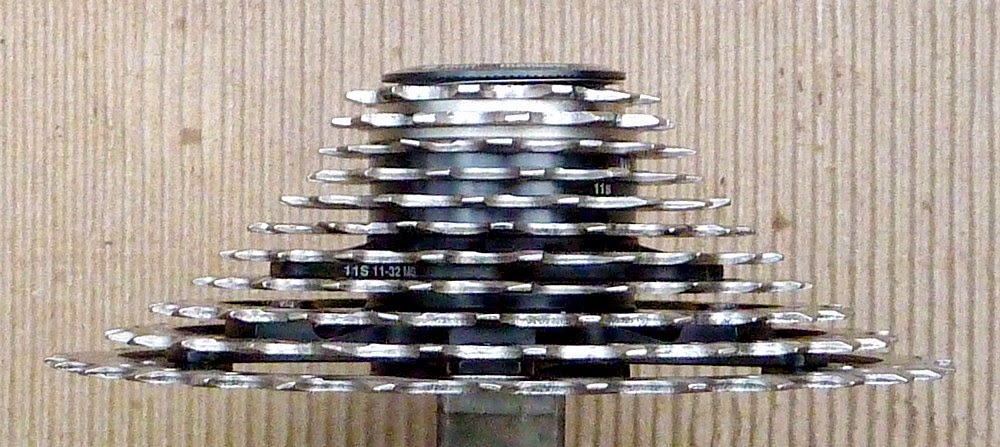
Despite the heavy overcast I persevered with photographing the 11 sp Ultegra cassette. The corrugated cardboard provides a neutral background. Using a darker or lighter background will usually confuse a camera's light measuring ability. Once fitted, it is difficult to capture the fine detail of this sophisticated unit.

Face on view and the sprocket sizes [tooth count] are all clearly stamped on each sprocket. As is 11s. The asymmetric perforations and wildly different tooth forms are interesting.
Oblique front view with more detail.

The tooth forms are different between the sprockets themselves and even around the circumference of each sprocket. Presumably the complex ramps are an effort to speed gear changing under load.

It is difficult to measure easily but I made the 11 speed Ultegra 40mm in depth. While the 10 speed is 38mm across the sprockets. The lockrings add a little extra. 
Front view of the disassembled cassette to show the carriers, sprockets and spacer rings. A far cry from the crude and heavy, 5-speed, solid, screw-on, sprocket blocks of my youth.
Rear view of disassembled cassette showing the carriers, sprockets and spacer rings. The two smallest sprockets have their own spacers built in.

The overall width of the 11sp cassette is supposedly too much for many/most 10 speed, bicycle freehubs.


Rear view. The carriers may be slightly askew relative to each other as they have not been located on the freehub splines.

The main carrier is non-magnetic and likely to be a light [aluminium] alloy. The smaller carrier looks rather like some sort of engineering plastic. Marked PA-CF suggests poly-amide carbon fibre reinforced. 

The sprocket cutaways are quite considerable. No doubt adding to the overall lightness of the cassette.

Oblique, rear view to show the two carriers and cutaway to the larger sprockets.

The square alloy pipe is just to prop the cassette on edge for photography. It is fitted into the plastic, decorative hub designed to keep everything together in the packaging.

11 speed Ultegra chain and box including joining pin. The HG-X compatible [road and MTB] CN-HG700-11 chain replaces the 6800. The links are coated with SIL-TEC inside and out for long life and low friction. Supplied already wet with oil, Shimano emphasises regular lubrication.


Interestingly, there are no instruction included in either package. The supplied multi-language sheets refer the buyer to their cycle shop supplier or a skilled cycle mechanic. Though there is reference to an online fitting manual for competent and professional bike mechanics the lack of a printed version does Shimano no real favours IMO.

What if the buyer has no access to the internet or is off the grid after purchase? A lot of equipment is bought online these days. With little chance of useful advice from some box shifting dealers. There may even be language problems when buying internationally online.

A couple of large and simple drawings is all that is required to ensure the correct chain length, fitted the correct way round and the correct fitting of the chain joining pin from the correct side using the correct tools. Perhaps Shimano are fed up with paying compensation to knuckle-dragging incompetents? Those who expect to be subsidised for their lifelong, drooling idiocy by a sympathetic jury and silver-tongued ambulance chaser.

Direct links to Shimano's PDF documents below:

Cassette details: http://si.shimano.com/php/download.php?file=pdf/dm/DM-CS0004-03-ENG.pdf

Chain fitting:  http://si.shimano.com/php/download.php?file=pdf/dm/DM-CN0001-02-A-ENG.pdf


Click on any image for an enlargement.
*

5 Mar 2015

5th March 2015 Shimano 11 speed options.


It seems that Shimano has added 11 speed kit while my attention was wandering elsewhere. Their 11-32 x 11 speeds Ultegra cassette costs about £45[equiv] or £30 for the 105 version online. Both need an 11 speed chains at £15, £25 and £30 for 105/Ultegra or Dura-ace. I doubt 10 speed TA chainrings will be a problem with the difference in width between 10/11 being so small. [Less than half a millimetre] An 11 speed system should work well with my 11 speed Chorus Ergo levers too. It seems the former incompatibility between different manufacturers gear components has been erased with the arrival of 11 speed. Except that Campagnolo still uses different splines on their free hubs. The special Trykit 2WD freehub will take any Shimano cassette, including 11 speed, but is not available with Campag splines.

A 43/33 double chainset with 11-32 11speed sp cassette will give me road speeds from 5 up to nearly 30mph @ 90-95rpm. I find my present 28 x 30 bottom gear too low to be very useful for anything. So a slightly higher 33 x 32 should be fine for climbing walls. A trike is not balance limited at very low speeds so there is never any point in "getting off" on a hill to walk. Pushing a trike uphill is hard work anyway. Because the nearest rear wheel constantly tries to run you over. If you walk behind the trike it doesn't self-steer like a bike. A 30mph top gear capacity is strictly for downhill use these days and I can always pedal faster to go any quicker. 120rpm is no effort at all for somebody used to high 90s average cadence.

The need for multiple, close ratio gears as analogous to a small racing motorcycle. The very high [pedal] rpm requires that there is never too much resistance to pedalling forces. If resistance increases beyond the comfort zone then pedalling speed drops rapidly. The twiddler becomes a pusher without the physical resources to be one.

While the true pusher is the equivalent of the big V8 engine. The brute power at low rpm from large muscles allows him to accelerate rapidly but he uses up lots of energy in doing so. As soon as his energy reserves are depleted he becomes weakened by lactic acid build up. Every hill becomes a vicious interval. Most sprinters are heavily built and often struggle on the big hills. Their own weight is an obvious disadvantage but they still cannot [usually] spin freely enough against a lighter load, for long enough, because of their greater muscle mass.

Being able to match rpm to their natural power band makes the skinny climber able to maintain a higher speed uphill. The "leverage" applied to the pedals is high but the load lifted per pedal stroke is very low. This is compensated for by using much lower gears and higher rpm. There are many more, but much smaller pushes per minute or per mile. Lactic acid build up can be much better avoided at higher rpm than ploughing on in a big gear at low rpm.

So the more gears, the better the climber can exactly match his desired cadence to road speed while still maintaining a low enough pedal resistance to avoid fatigue on a given incline. Climbing in a low enough gear should essentially become a normal training ride. Spinning freely without serious effort per pedal stroke avoids fatigue. Since the cyclists is always fighting a headwind, of his own making, the need for close ratio gears holds true even on the flat.

The trick is to have the fitness and stamina to be able to keep spinning for long periods. While pushing a slightly higher gear, or using even higher rpm than the opposition, will maintain a higher road speed to reach the finish line first. Chris Froome shows the skinny climber's ability to spin very freely but lacks the raw power to accelerate. While the crafty opposition dances on the pedals in higher gears to pull away they use much more energy in doing so and seriously risk burning up on lactic acid.      

Here's a brilliant visual gear calculator where the sprockets and chain rings can be changed simply by dragging them along with the cursor:

http://www.gear-calculator.com/

If you want a triple just drag the left chainwheel onto the scales and then adjust the chainring sizes to taste by sliding them along until the required tooth numbers appear.

Gear-calculator screen shot: Note the speed scale along the bottom below the tooth count scales. Having lots of gears around your average cruising speed allows for variations in tiredness level, headwind and changing incline.

I can still remember working out my gears longhand back in the 1960s  before electronic calculators became commonplace. Now this clever software completely eclipses dry tables and raises usability to a whole new level of sophistication!

Gear inches = [Wheel diameter in inches x No. of chainwheel teeth] / No. of sprocket teeth.
For example: 27" x 48 / 18 = 72" Which used to be a popular gear for fixed gear time trialling.
This was the highest fixed gear allowed for young competitive cyclists and probably led to a lifetime of twiddling. Riding fixed gear in a hilly area is a wonderful way of learning to pedal really fast!

BTW: Gear inches represents the equivalent size of an Ordinary [slang: penny farthing] wheel with fixed cranks and no gears. Before gears were invented the wheel size of the "high wheeler" was limited by the inside leg measurement of the rider. Since the wheel size sets the direct drive [fixed] gear ratio a high cadence [very rapid pedalling] was the order of the day to achieve high speeds. The rider would usually lift their feet off the pedals on steep or long descents. Given the parlous state of the roads at the time "doing a header" was a common occurrence! Yet ironically the large wheel smoothed the rough roads far better than the early safety bicycles and tricycles. Hence the invention of the pneumatic tyre and the sensible standardisation on 26-28" wheels despite some [arguably minor] road improvements over the last century or more.

Click on any image for an enlargement.
*

4th March 2015 Shimano 6800 Ultegra 11sp Cassette

*

 Wednesday 4th 34F, +1C, breezy, very heavy overcast, light rain. There was some light overnight snow. We have been promised some sunny periods but with wintry showers. The snow is falling heavily now just before 9am. With wintry showers continuing and heavy spray following every vehicle I went for a walk instead of a ride. It stayed dry but very heavily overcast.

Ultegra 11sp 11-32 cassette and lock ring. 

Late afternoon overcast has severely limited the image quality. The bright finish on the sprockets does not respond well to flash. The relative orientation of the sprockets is random in this shot. Things will probably 'tidy up' when the cassette is located on the splines of the Trykit 2WD freehub.

I shall take some more images tomorrow in better light.

I spent hours online today researching possible 11 speed gear systems and their compatibility. The cost of 10 speed kit is still too similar to 11sp to be worth replacing like with like. Some dealers are still asking more for the 10 speed kit than I paid for the latest 11 speed kit! 11 speed makes much more sense as long as the existing equipment is up to the task. 11 speed levers are the most obvious requirement to be able to select all 11 gears.


Reinvestment in a whole new 11 speed groupset would require far more thought. Not least to establish the best entry level to choose amongst the various manufacturer's offerings. The slight reduction in weight, with much higher costs, is usually pure psychology, hype and advertising and has no real meaning out on the road. Half a bottle of water weighs more than the difference between the bottom and top of the sales hierarchy. The top end appeals largely to the snob value of owning the correct [and constantly updated] lightest bling. Other factors suggest that most of the advantages of the latest kit can be had from the more humble, lower levels of equipment. Another rest day.


Ultegra 11sp cassette exploded view showing the two sprocket carriers and only three normal spacers. I promise to take much better pictures tomorrow.

Thursday 5th 33-38F, 1-3C, bright frosty start. Still but becoming windier from the west. The forecast was for increasing cloud with sunny periods but it has already become overcast by 10.20am. I enjoyed a walk to the more distant woods. With the firm, frosted soil it was easy to cross fields by the spray tracks to avoid using the roads during the rush hour. Though it had thawed to muddy by the time I returned by road later. Lots of Great tits in the woods and hedges. Saw several buzzard sized birds of prey. Plus a solitary Greenfinch perched on the top of a 50' conifer.

Ultegra 11 sp cassette obverse showing two black sprocket carriers. One holding the largest three sprockets and the second; the 4th and 5th gears. The rest of the sprockets are loose and directly mounted onto the splines of the freehub. The black, central, plastic plug seen here is just to hold the sprockets together in the presentation packaging. The Ultegra 11sp cassette is remarkably light thanks to the carriers and sprocket cutaways. 

I rode to the shops in three different villages after coffee. Collected my 11 speed Ultegra cassette and chain from the local post office. Ordered online yesterday afternoon and posted the same day for next day collection. Huge range, great prices, superb communications and no P&P for local collection. Which I much prefer to waiting all day for the postman not to turn up. They always throw in a few sweets as well. Cykelpartner.dk must be the best online bike parts dealer on the planet!

Getting quite used to the aero bars now and able to keep it up for miles at a time. Downside is a tendency for my lungs to get bunged up from lying almost flat. It feels as if I have to come up for air occasionally. I have no idea what drivers think of me bombing along on my trike at 20mph. They're probably wondering why I always have that huge, pink sports bag hanging off the back! At least I can pretend it is legal streamlining. Perhaps I should do some wind tunnel testing? 29 miles. 

I can't fit the new cassette and chain to the trike until my new Spa DT-2 double chainset turns up. Those who think I spend too much money on new trike bits might consider that I ride further in a good week than I drive the car per year. My trike is my daily transport for probably 99.5% of our shopping. The trike keeps me fit and [almost] sane and costs a fraction of the expense of annual car maintenance and most people's expenditure on fuel alone. The car is only used for heavy lifting these days. It is completely ridiculous to keep the car given the cost of its upkeep, insurance and tax, for such very low mileages. However, it provides vital emergency transport for our rural existence.

Friday 6th 40F, 4C, light breeze, very heavy overcast, showers possible.Walked for an hour and a half.
Rode to the shops after lunch. Three special offers. Three different shops. No stock! Saw lots of birds of prey in the fields and hedges. My email service won't let me receive or send emails. Server error. Password or user name login error. There is no contact with the email service provider unless I pay £23 in advance per year. I tried to register the same email address in Firefox and was told the server was using a false certificate. Quite possibly identity theft. Did I want to bypass all their [Firefox's] server security checks?

This same outfit with the strangely opaque website took over all email service on the fibre optics network from the Danish regional energy companies. We were promised exactly the same [free] service as before. Just like they GUARANTEE the speed of their Internet service as part of their sales hype. Lies, damned lies and the Danish electricity companies! At least we could ring somebody up for assistance before Lightmail.dk took over! Emails are the banks, business, kommune and government agents' means of reminding their citizens that they should be checking their information and accounting websites regularly online. 18 miles.

Click on any image for an enlargement.

*