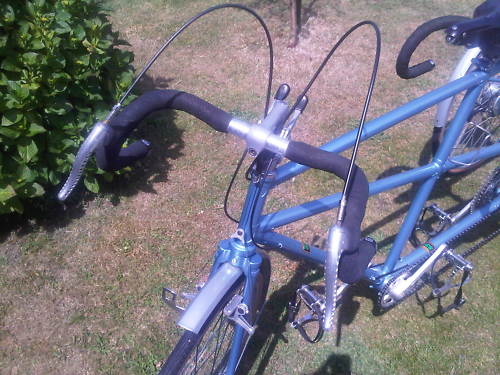
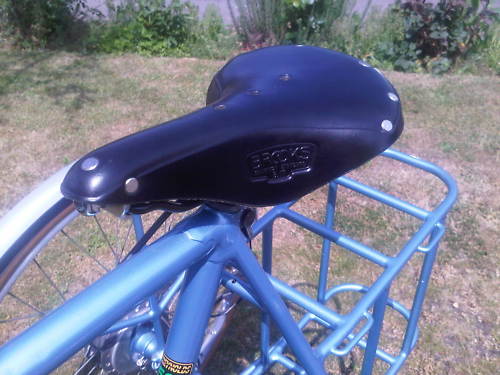
Another trike has come up on eBay(UK).
A TRIKE FRAME BY C. BERTRAND & Co TRICYCLE RACING FRAME on eBay (end time 12-Sep-10 18:59:54 BST)
This time a 24" by C Bertrand of London. I completely missed the auction but thankfully a contact kindly emailed me just after the event. I shall have to fine tune my eBay saved searches to capture any racing trikes up for auction.
685 views and 25 bids ending in £196.55 suggests that buyers knew exactly what they were bidding for. Judging by the few remaining accessories I'll hazard a (very) wild guess of 1950s - early 1960s at the latest.
All images are "borrowed" from the vendor's eBay auction. I have resized them upwards from the 500x375 originals to 800 x 600. Then "sharpened" them slightly in PhotoFiltre for the blog. Usually gamma+ and contrast + crisps things up nicely.
If the new owner is reading this I would be most grateful for larger images showing much more detail. (triker

The overall view of the C Bertrand trike. Old steel HP wheels and early steel calliper brakes. Neat "Wrap over" seat stays and what looks remarkably like a Higgins rear axle. Rather high, Chater-Lea, eccentric bottom bracket set. The pedals can't hit the ground on corners so there is no need for so much ground clearance on a trike. A lower bottom bracket allows the rider to sit lower keeping his/her Cof G lower. Nothing obviously unique so far. The forks are typically trike or pre-modern. It is known that Higgins provided axle assemblies for independent frame builders. No doubt I will hear about it eventually if I'm wrong.

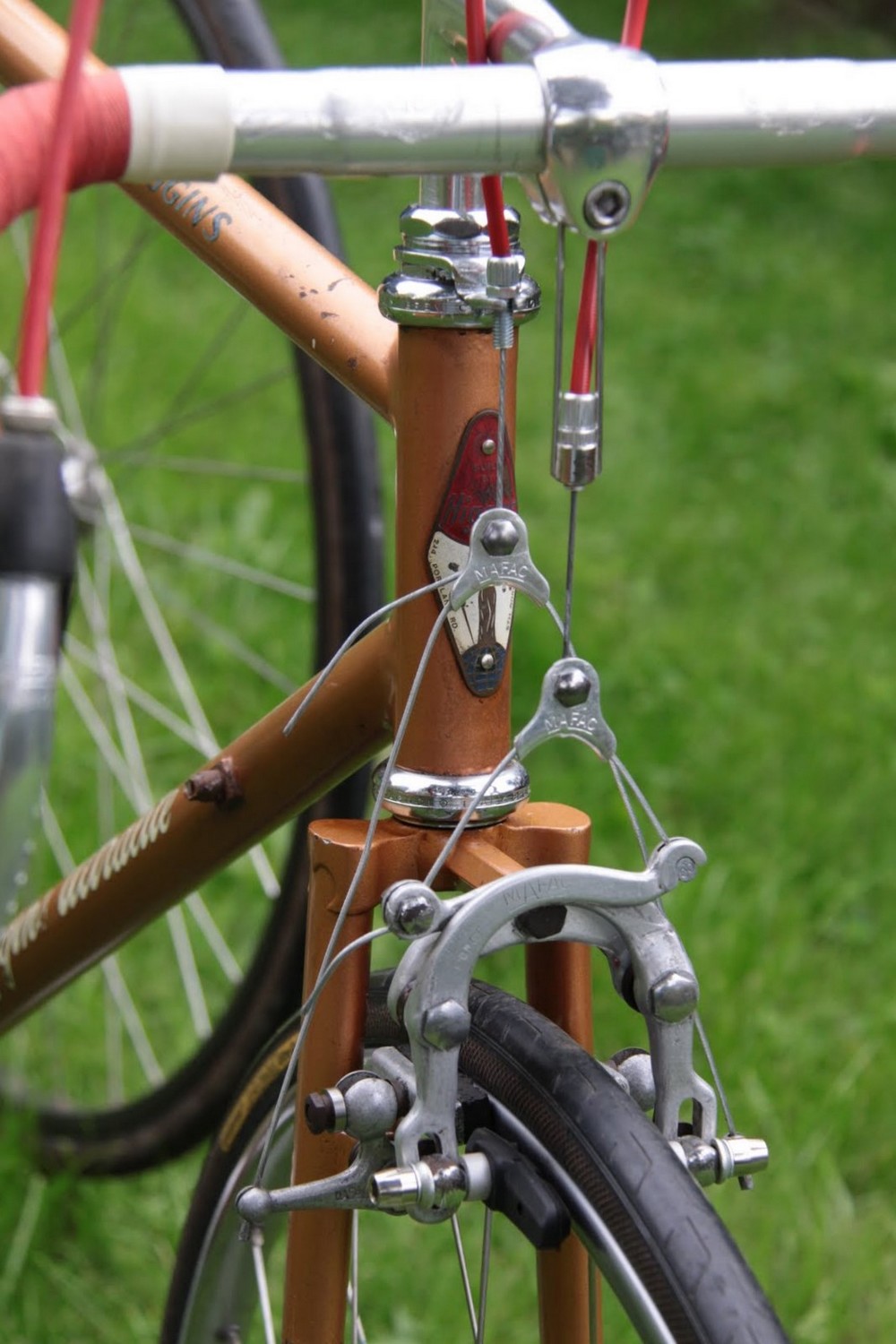
The interesting, plated steel, cantilever front brakes by Mafac. I don't have any real idea as to date. They look as if they'll clean up nicely and I doubt they weigh any more than any, more-modern, alloy type. A nice, original feature.

The maker's signature on the down tube is tastefully done. I'm fairly sure the Huret gear change lever is a bit earlier than my own early 1960s introduction to sporting and racing bikes. I had Huret gears myself at one point but I don't remember anything like this. I moved to bar-end Campag levers early on so my memory may well be playing tricks. (It usually is)

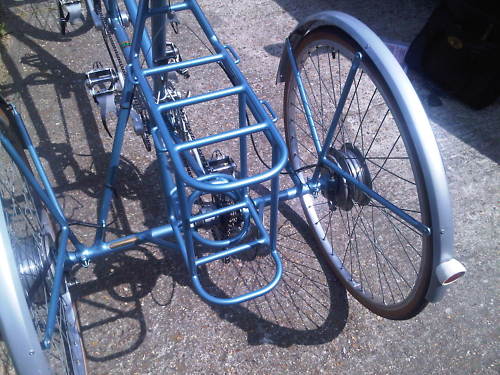
The axle reinforcing loops look very similar to my 1954 Higgins. Typical screw-on, close ratio, 4 speed, sprocket block probably indicates a dedicated, time trial machine. Easily upgraded with a Trykit freehub adaptor kit if more speeds are desired. The Trykit website is "off the air" so I wont link to it just now.

C.Bertrand seat tube badge. "Tally-Ho Corner", 654 High Rd. N Finchley, London N.12. Why the reference to hunting on horseback? Possibly a coincidence of address? Please feel free to educate me if you know any more about this trike or its builder. (see Comments below for full details)

The view of the idler axle bearing from the other side of the sprocket block. Typical bottom bracket cup and lock ring. The end of the idler axle is visible in the bearing cup aperture.

The Chater-Lea, eccentric, bottom bracket set. The axle is designed for cottered, steel cranks but easily changed to something more modern if desired. The clamping bolts looks as if they need a good soak in penetrating oil. The eccentric body allows chain tension adjustment by rotation of the entire assembly. The two clamping bolts, underneath the bottom bracket shell, are them tightened to hold the chosen setting. I tried to brighten the shadows in this image but it is still difficult to see the dark crescent to the right of the bottom bracket assembly. This dark crescent is the (outer) eccentric body with the oversized, steel frameset shell.

The vendor has attempted to brighten an original HP steel rim with steel wool. Given that the spokes are also rusty a new set of wheels would improve the cosmetic appearance of the trike considerably. This assumes (of course) that the new owner does not want to maintain an original, period look. I myself replaced the rusty wheels on my Higgins and consider it a great improvement. Not to mention much less work to keep them looking "tidy". As fast as I rubbed the original wheels with fine steel wool they rusted over again. It is virtually impossible to clean around the ferrules, hubs, nipples and spokes properly without access to sand blasting. (or similar, more gentle methods) The fastidious restorer could no doubt source steel components in better condition if total originality is sought.
I can't see any transfers describing the frame materials. Can we assume Reynolds 531 butted tubes are used on the frameset triangle?

The Bertrand partly wrapped for onward carriage. I would prefer to see every tube covered in foam pipe insulation. Then tightly wrapped on top of the foam in several layers of box cardboard and taped really well. Cardboard over foam is an amazingly strong structure offering far more protection than the foam wrapping alone. The tape is also vitally important to ensure the cardboard doesn't come loose. Loose cardboard immediately loses its stiffness and resistance to bending and crushing forces. Foam cored panels and tubes are used for some very serious stiffness in some very high.tech. structures. A strong skin is vital to their design. In its place, at much lower cost and much greater bulk and weight, the taped, cardboard, thick-wall "pipes" over the foam does well enough for our purposes.
As shown, the wheels offer some extra protection to the delicate frame tubes but not nearly enough. Lightweight cycle frames have very thin tubing and its high tensile strength is not perfect protection to localised impacts. In carriage, an object is likely to meet any number of unforeseen risks. Undoing damage is infinitely more difficult, expensive and time consuming than an extra bit of foam. Plus an extra quarter of an hour wrapping everything very tightly over the top in free, scrap, cardboard packaging from the local supermarket.
All this should take place before the machine is boxed. A bike box is merely cosmetic unless the contents inside are very well protected. My own, decades-long experience of dealing with deliveries of all kinds does not bode well for anything not suitably armoured for the perilous journey.
Time and again I have seen bored, underpaid and uncaring delivery staff deliberately drop delicate objects from raised vehicle tail lifts or from shoulder height. I have watched countless attempts to use other packages and pallet trucks as battering rams to move packages around within their delivery truck.
The presence of others does not alter their pattern of behaviour one iota. They have no personal investment in the care of the packages and it shows in their body language and manner. They are high turnover, disposable, delivery fodder running on a low grade level of rage. The very few who actually care stand out like sore thumbs! But are much more likely to move onto pastures new. Usually due to the total lack of positive feedback from their employers. Nor do they get any from the receiving staff at their delivery points. The driver faces awful traffic every single day and is an outsider without sympathy at every delivery point. Their employers compete by undercutting their staff's wages and placing onerous delivery schedules on their bowed shoulders. It's a no-win situation for anybody in the chain (including those who paid for the supposed service) and you must be prepared for it.
Meanwhile, back at the ranch, progress is being made in the restoration of this fine trike:
http://s1092.photobucket.com/albums/i418/Tricyclist/
Click on any image for an enlargement. Back click to return to the text. Do the same with links.
*




gB2k~$(KGrHqF,%21iUE%29qzNdBIiBMcV%28B14Og%7E%7E_12.JPG)

 5
5